
LaReeca Rucker
The Clarion-Ledger
From the archives Nov. 29, 2010
If Sharon McConnell-Dickerson could see, she might still be living in New England with no knowledge of Mississippi’s rich blues heritage and no interest in art.
But because her vision began to fade in 1995, she turned to art to cope. That decision eventually brought her to the state where she began working on a decade-long project creating lifecasts of the faces of legendary blues musicians.
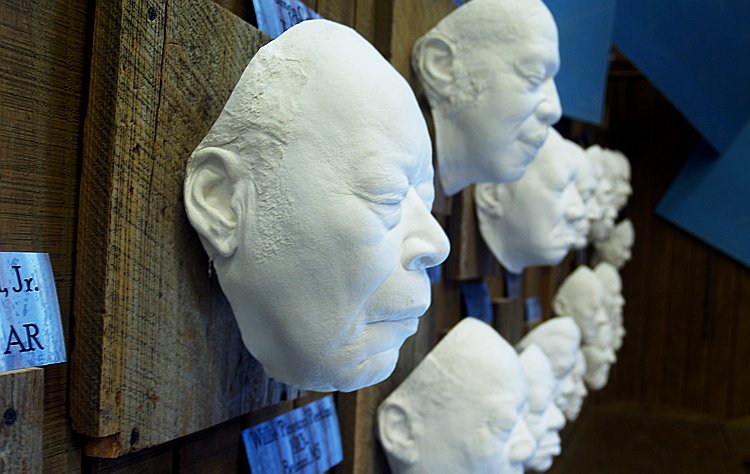
The original casts have been exhibited at Delta State University since 2008, and a smaller exhibit is now housed in Cleveland’s Martin and Sue King Railroad Heritage Museum.
“It’s a different recording than laying down tracks in a studio,” McConnell-Dickerson said. “They are leaving a very personal piece of their legacy, their exact image.”
The process takes about 15 minutes to complete using specialized molding materials that cover the face and harden.
While Greenwood native and blues guitarist Hubert Sumlin laughed and found the process “beautiful,” McConnell-Dickerson said the late Lafayette County blues artist R.L. Burnside said, “I feel like a snake. You just took something from me. It feels good.”

“When I touch a person’s face and do a casting, there is an energy that is exchanged between my hands adorning them very carefully with this material,” she said.
“I would come back to my hotel room lots of times filled with intensity and vibrancy. Other times, I would be silent like I was in some kind of trance. Sometimes, I would cry and release what I felt was pain.
“With all the changes I’ve had in my life — going blind, having to recreate myself, reengineer my life, losing my livelihood and my identity — this project has helped me get through that and gave me a different perspective of my life.”
Before life led her to art, the Connecticut native worked as a cosmetologist and chef on a private jet.
“I only came to art as my sight was failing me,” she said. “A friend introduced me to clay, and that moment changed my entire life.”
She moved to Santa Fe, New Mexico, in 1996, intending to enroll in art school, but said she faced rejection because of her visual impairment.
“It was a blow, but a gift,” she said.
Instead, she spent the money for tuition on private lessons. Ten months later, she had a one-woman show at a notable New Mexico gallery and was featured in an arts publication.
“There are so many great works of art that have been done with little or no eyesight,” she said. “Monet painted ‘Water Lilies’ when he was almost blind. What if we had never had that series and perspective?”
Emily Erwin Jones, Delta State University’s archivist, said the college houses the artist’s 55 original masks.
“Some even have makeup and hair …” she said.
“It’s more than a photograph. It’s a snapshot of a moment in time with the lines of their faces.”
Lisa Miller, director of the railroad museum at 115 S. Bayou Ave. in Cleveland, said 20 mask replicas are on display in an exhibit called Rhythm and Rails, the Music of the American Railroad.
Miller said one railroad line ran across the county from Dockery Plantation near Cleveland that is known to many as the birthplace of Delta blues.
“Because of the way it twisted and turned across the county, it was nicknamed, ‘The Peavine,’ ” she said.
Miller said Delta bluesman Charley Patton recorded a song called Peavine Blues about the railroad, and bluesman Robert Johnson, who also lived and worked at Dockery, recorded Traveling Riverside Blues, a song that mentions the neighboring town of Rosedale.
“Eric Clapton took Traveling Riverside Blues and Cross Road Blues by Robert Johnson and blended them into his version of Crossroads,” she said.
Miller expects the exhibit to continue through January and possibly longer.
She said organizers would like to see the masks bronzed and placed on a walking trail with descriptions written in Braille and positioned at a handicap-accessible height.
McConnell-Dickerson recognized that so many of these musicians “are leaving us at an alarming rate,” Miller said.
Two weeks after creating his mask, Othar Turner died in 2003 at age 95. Burnside died in 2005.
Shelby native Henry “Mule” Townsend, Laurel native Sam Myers; Robert Lockwood Jr., who performed throughout the Mississippi Delta; and Jessie Mae Hemphill all died in 2006. Tennessee native Koko Taylor died last year.
Taking a break from lifecasting, McConnell-Dickerson now writes a weekly newspaper column and plans to help develop a summer arts program for children.
She also bought a historic Victorian home she’s spent the last four years restoring.
“One of the musicians gave me the name of Blind Faith,” she said. “It was really a blind leap of faith to come here and buy this old house.
“There were many serious flaws and conditions in the house I was unaware of when it was sold to me. When I could have fled, I didn’t.”
That’s because she’s fallen in love with Mississippi.
“What I love and dislike about Mississippi at the same time is that it’s not going to change much,” she said. “Mississippi is so raw and really untouched. It’s precious to me.”