
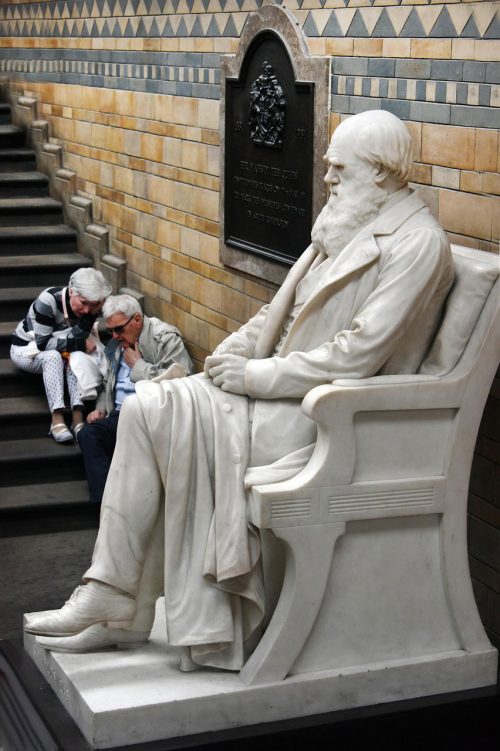
With the 150th anniversary of “The Origin of Species” and the 200th anniversary of Charles Darwin’s birth falling just a year apart, New York Times science writer Olivia Judson recently predicted a surge of “Darwinmania.”
And for good reason — few scientists have had as lasting and polarizing an impact as Darwin, whose theory of natural selection reshaped our understanding of life on Earth.
I bought “The Origin of Species” a while back, mostly out of curiosity and the desire to own a copy of a book that’s still at the center of heated debates in schools, politics and religion. I’ll admit — I haven’t finished it. Like many readers, I tend to buy books faster than I can read them. But the parts I have read were eye-opening, not because they were controversial or philosophical, but because they were so rooted in observation, logic, and science.
For those who haven’t read it, “The Origin of Species” is less about trying to push an agenda and more like a 19th-century science textbook. Darwin doesn’t spend much time philosophizing about the meaning of life or trying to provoke religious institutions.

Instead, he meticulously details his studies of pigeons, beetles, orchids, and other life forms to support his idea: that species change over time through a natural process that favors traits aiding survival and reproduction — what we now call natural selection.
Interestingly, the word “evolution” is barely mentioned in the first edition, and yet it’s the one that ignites controversy. “Natural selection,” for some reason, seems more palatable — even to those who are uncomfortable with evolutionary theory. That might be because it sounds more clinical, less loaded with philosophical implications. And yet both terms describe the same idea: that living things adapt over time, not by accident, but by necessity and survival.
As someone who was raised in a region where creationism is still commonly accepted, I’ve often wondered why belief in God and acceptance of scientific processes like evolution must be mutually exclusive. Couldn’t a higher power have set natural laws in motion? When someone says “Let there be light,” could that not include physics, chemistry, and biology working in harmony to shape our world over time?
After all, most of the miraculous processes we accept every day — electricity, the internet, human birth — can be described both scientifically and spiritually, depending on your perspective. Maybe the challenge isn’t the science or the faith, but our struggle to let them speak the same language.
So no, I haven’t finished Darwin’s book. But I intend to, eventually. Not because I need to be convinced, but because it remains one of the most important scientific works in human history — a book that still dares us to think critically, to observe, and to question. And maybe that’s why it still stirs debate, 150 years later.

You must be logged in to post a comment.