
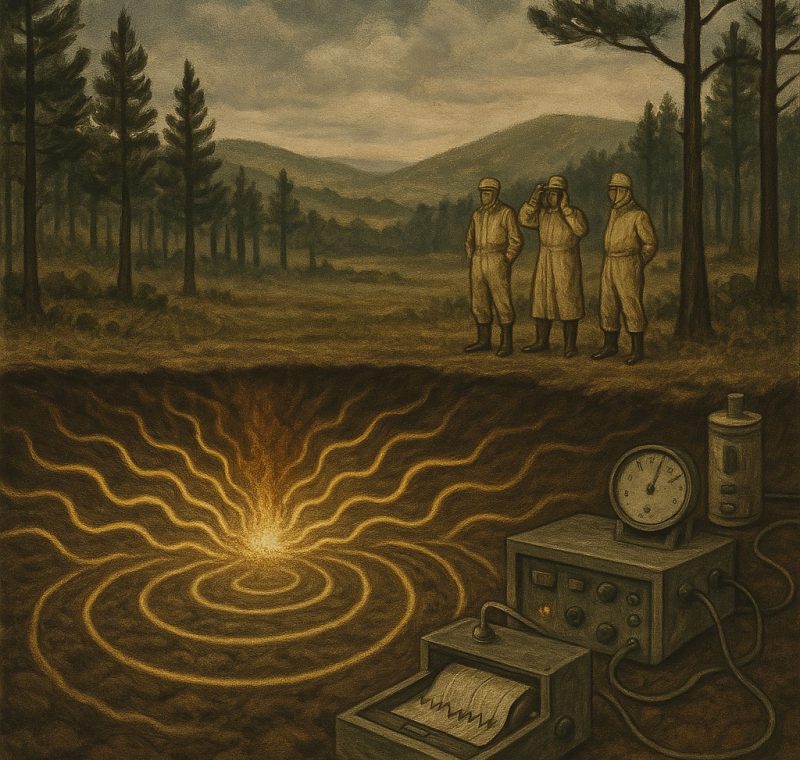
Kevin Saul was just 7 when government agents showed up at his Lamar County home and evacuated his family three miles away. Why? To protect them from an underground nuclear test — a blast so strong, it buckled the ground beneath their feet.
“It felt like an earthquake,” Saul recalled. “It knocked you off balance.”
The 1964 nuclear test, code-named Salmon, was part of Project Dribble, a Cold War experiment that took place deep within the Tatum Salt Dome. It remains the only nuclear detonation ever conducted east of the Mississippi River.
The goal? To figure out whether U.S. technology could detect underground nuclear tests in places like Russia. It worked.
David Allen Burke, author of “Atomic Testing in Mississippi,” says the experiment — though public and well-reported at the time — left a lasting mark. The explosion damaged local homes, including Saul’s, and rattled nerves for miles. “It was like a magnitude 6 earthquake,” Burke said, referencing readings taken over 100 miles away.
A second, smaller test called Sterling followed in 1966, and additional non-nuclear tests were conducted through 1970. The land, once returned to the Tatum family, was later acquired by the Department of Energy and eventually turned over to the Mississippi Forestry Commission. Today, it’s part of the Jamie Whitten State Forest, used for experimental tree farming and monitored regularly for radiation.
Burke said although fears of contamination persist, studies show no significant health risks. Still, he understands the worry: “The lack of communication from the government after the tests created more fear than necessary.”
Mississippi forester Wayne Tucker said radiation checks continue, with over two dozen water wells monitored quarterly. Only one tree has ever shown traces of radioactive material.
“It’s a strange and fascinating chapter in our history,” Tucker said. “And it played a key role in ending the Cold War.”
