
When Sharon McConnell-Dickerson began to lose her vision in 1995, she faced a difficult truth: her life would never be the same. But in the darkness, she discovered something unexpected — art.
That discovery eventually led her from New England to the Mississippi Delta, where she would spend more than a decade capturing the soul of the blues, not through sound, but through sculpture.
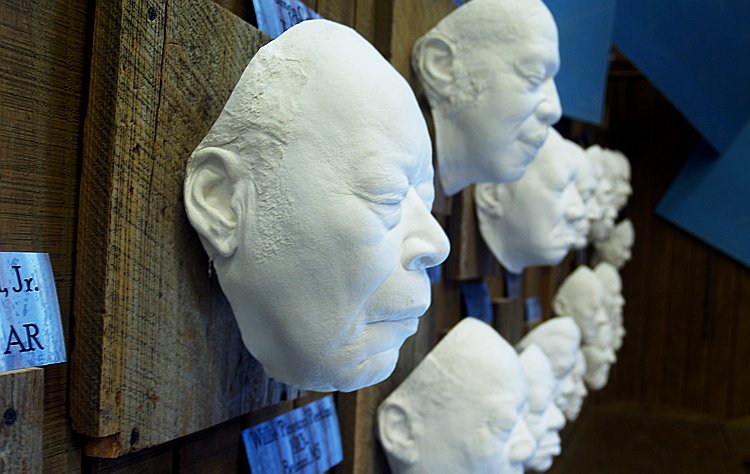
McConnell-Dickerson’s mission became clear: to create lifecasts of legendary blues musicians’ faces before they disappeared from history. Her work preserves not only the contours of their features, but a deeper, spiritual imprint — the lines of resilience, the curve of sorrow, and the expression of generations shaped by hardship and hope.
“This project gave me a different perspective of my life,” McConnell-Dickerson said. “With all the changes I’ve had — going blind, losing my livelihood, my identity — I had to reengineer everything. This gave me purpose.”
Today, her original lifecasts are housed at Delta State University, where they’ve been on exhibit since 2008. A smaller, traveling collection can be found at the Martin and Sue King Railroad Heritage Museum in Cleveland, Mississippi.

The location is fitting. Blues history runs deep in this part of the state. A railroad line known as “The Peavine” once stretched across the county from Dockery Plantation, which many call the birthplace of Delta blues. It’s the same region that inspired musical greats like Robert Johnson — whose work would later be reimagined by artists like Eric Clapton, who fused Johnson’s Traveling Riverside Blues and Cross Road Blues into his iconic version of Crossroads.
McConnell-Dickerson’s lifecasting work took on an added urgency as blues legends began to pass away. Othar Turner died in 2003, just two weeks after sitting for his cast at the age of 95. R.L. Burnside followed in 2005. In 2006 alone, the world lost Henry “Mule” Townsend, Sam Myers, Robert Lockwood Jr., and Jessie Mae Hemphill. Koko Taylor passed away in 2009.
Unlike audio recordings, McConnell-Dickerson’s work leaves a tactile, physical legacy — a final impression of the people behind the music. “It’s different than laying down tracks in a studio,” she said. “They are leaving a very personal piece of their legacy — their exact image.”
Some of the artists gave her a nickname that seems perfectly fitting: Blind Faith.
Moving to Mississippi, she admits, was a leap of blind faith itself. “What I love and dislike about Mississippi at the same time is that it’s not going to change much,” she said. “Mississippi is so raw and really untouched. It’s precious to me.”
So are the faces she has preserved — etched in plaster, frozen in time, and glowing with the spirit of the blues.

You must be logged in to post a comment.